Home
How to Use 18th Edition Tabs to Pass Your BS7671 Exam Faster
The BS7671 Wiring Regulations exam is a high-pressure environment. Candidates are faced with 60 complex technical questions and only 120 minutes to answer them. This leaves exactly two minutes per question to read the prompt, locate the relevant regulation in a 500-page manual, and select the correct answer. For many, the difference between a pass and a fail isn't technical knowledge, but the speed of navigation.
Strategic tabbing, particularly for the 2026 "Orange Book" (Amendment 4), stands out as a top choice for increasing efficiency. By organizing your book into logical, color-coded sections, you transform a dense technical manual into a searchable reference tool. According to expert consensus, manual page-flipping without markers can waste nearly a minute per search, which quickly compounds into a time deficit during the final quarter of the exam.
What Are the Official Rules for Using Tabs in the 18th Edition Exam?
Before you begin applying adhesive markers to your expensive regulations book, it is vital to understand the compliance landscape. City & Guilds and EAL have specific regulations regarding what constitutes a "permitted material." While the rules are generally accommodating, a single mistake can lead to your book being confiscated at the exam center door.
According to the City & Guilds 2382 handbook , candidates are allowed to use bookmarks. These can include blank post-it notes, commercially available pre-printed tabs, or even folded page corners. Highlighting text within the book is also explicitly permitted, which helps in identifying key phrases once you have reached the correct page.
It is also important to account for the "Invigilator Factor." While official guidelines allow for tabbing and highlighting, individual test centers occasionally enforce stricter "clean book" policies. Invigilators, who may not be technically trained in electrical standards, often default to a cautious approach. If they suspect your tabs contain hidden information, they may require their removal. For this reason, using removable adhesive tabs is a safer strategy than using permanent glue or staples.
Why the 2026 Orange Book (Amendment 4) Requires New Tabs
As of 2026, the "Orange Book" (Amendment 4) has replaced the previous "Brown Book" (Amendment 2) as the industry and exam standard. If you are using tabs designed for older versions, you will likely encounter significant navigation errors. The structural changes in Amendment 4 have shifted page numbers throughout the manual, particularly in the later sections.
Key changes in Amendment 4 include updated requirements for Electric Vehicle (EV) charging installations, solar photovoltaic (PV) systems, and revised protection requirements against thermal effects. These new sections have pushed existing regulations to different page numbers. Using Amendment 2 tabs on an Amendment 4 book will lead to "mis-indexing," where a tab labeled "Part 7" might land you in the middle of Part 6.
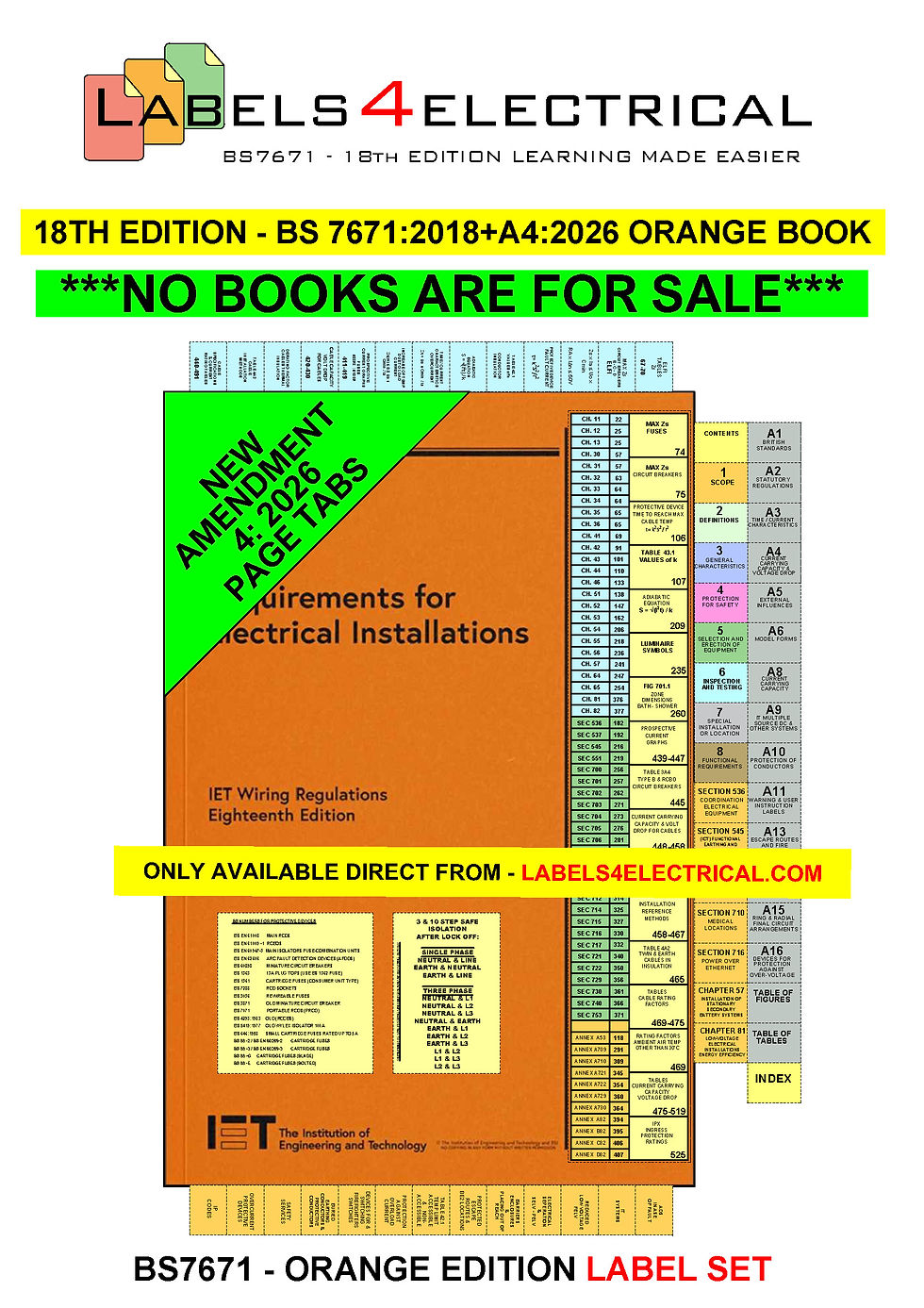
Image source: Labels4electrical
Furthermore, the introduction of the Corrigendum—a set of corrections issued by the IET—is often required to be carried into the exam. Many modern tab sets now include specific markers for these corrected sections, ensuring you are looking at the most current data during your 120-minute window.
The "Question-to-Part" Mapping Strategy for 2-Minute Answers
One of the most effective ways to use 18th edition tabs is to align them with the chronological flow of the exam. The City & Guilds 2382 exam generally follows the structure of the BS7671 book from front to back. By tabbing the start of each "Part," you can immediately narrow your search area based on which question number you are currently answering.
Expert forum consensus suggests that mapping questions to specific Parts is a highly efficient way to manage time. Below is the typical distribution of questions in the 2382 exam:
- Questions 1–4: Part 1
- Scope, Object, and Fundamental Principles.
- Questions 5–6: Part 2
- Definitions (Crucial for terminology-based questions).
- Questions 7–12: Part 3
- Assessment of General Characteristics.
- Questions 13–27: Part 4
- Protection for Safety (The largest and most critical section).
- Questions 28–41: Part 5
- Selection and Erection of Equipment.
- Questions 42–45: Part 6
- Inspection and Testing.
- Questions 46–52: Part 7
- Special Installations or Locations.
- Questions 53–60: Part 8 & Appendices
- Functional Requirements and Supplemental Data.
By placing a tab at the start of each of these blocks, you eliminate the need to guess where to start looking. If you are on Question 30, you know instinctively to flip to your "Part 5" tab. This "Question-to-Part" mapping is widely considered one of the strongest methods for maintaining a steady pace.
How to Place Your Tabs for Maximum Speed During the Exam
Physical placement is just as important as the information on the tab. A common mistake is "over-tabbing," where a candidate places 50 or more markers in the book. This creates a cluttered edge that makes it difficult to read the labels and can actually slow you down. Instead, focus on a "staircase" alignment.
Stagger your tabs from top to bottom along the outer margin of the page. This ensures that no tab is hidden behind another. A top-tier strategy involves color-coding your markers:
- Blue Tabs: Major Parts (1 through 8).
- Red Tabs: High-frequency Tables (e.g., Table 41.1 for disconnection times).
- Green Tabs: Essential Appendices (e.g., Appendix 3 for time/current characteristics).
Beyond the major Parts, there are specific "High-ROI" (Return on Investment) tables that you should always mark. Table 41.1 (Maximum earth fault loop impedance) and Table 52.2 (Cable selection) are referenced frequently in exam questions. Having a dedicated, brightly colored tab for these tables can save you from searching through the index multiple times.
"The 2-Minute Rule: If you haven't found the answer in 60 seconds using your tabs, flag the question and move on. Don't let one tricky search ruin your timing for the rest of the paper."
Should You Buy Professional Tabs or Make Your Own?
Candidates often debate whether to invest in professional laminated tab sets or stick with DIY paper post-its. While both are legal, they offer different levels of utility during the stress of the exam. Professional sets, which range in price from £7 to £36, are specifically designed to fit the dimensions of the BS7671 manual without obscuring the text.
| Criteria | Professional Tabs | DIY Post-its |
|---|---|---|
| Durability | High (Laminated, tear-resistant) | Low (Paper, prone to curling) |
| Legality | 100% (If pre-printed correctly) | 100% (If left blank) |
| Price | £7.49 – £36.00 | £1.00 – £2.00 |
| Ease of Install | Includes alignment cards | Manual alignment required |
The primary advantage of professional tabs is their durability. During the exam, you will be flipping pages rapidly. Cheap paper tabs often tear or lose their adhesive, which can be a major distraction. Furthermore, professional sets often come with an "alignment card" that helps you achieve a perfect staircase layout, preventing the "staggered mess" that often occurs with hand-placed notes.
However, DIY tabs are a popular choice for those on a budget. If you choose this route, ensure you use high-quality adhesive and consider placing a small piece of clear tape over the tab to prevent it from tearing. Regardless of the type you choose, the goal remains the same: clear, legible markers that guide you to the correct section in seconds.
Common Mistakes That Get Your Regs Book Confiscated
Even with the best intentions, some candidates inadvertently break the rules, leading to their book being barred from the exam room. The most frequent violation is the inclusion of handwritten notes. While you might think a small formula or a cross-reference to another regulation is harmless, invigilators are trained to look for any "added value" that isn't part of the original printed text.
Another common pitfall is "non-standard inserts." You should never tuck loose sheets of paper, photocopied tables, or printed cheat sheets into your book. Even if they are not tucked into the pages, having them inside the cover can lead to suspicion. If you need to use the Corrigendum, ensure it is the official version and is kept as a separate, permitted document rather than being pasted into the book.
Finally, avoid "over-tabbing." If your book becomes so bulky with markers that it cannot close properly, it may be flagged for inspection. A clean, well-organized book with 15–20 strategic tabs is far more effective—and less suspicious—than a book with 60 tabs that obscure the page numbers and regulation headings.
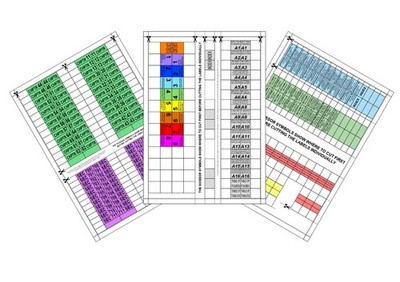
Image source: eBay UK
Frequently Asked Questions
Can I use the Corrigendum with my tabs?
Yes, the Corrigendum is considered a permitted material for the City & Guilds 2382 exam. You can tab the Corrigendum just as you would the main book, provided you do not add any handwritten notes to it. Many students find it helpful to place a tab on the specific regulations in the main book that have been updated by the Corrigendum to remind them to check the supplement.
Are pre-printed tabs legal for the exam?
Yes, pre-printed tabs are generally accepted by most exam centers and invigilators, provided they only contain the names or numbers of the Parts, Chapters, or Tables found within the book. They must not contain additional explanations, formulas, or "cheat sheet" style information. If you are concerned, check with your training provider 24 hours before the exam.
Can I highlight my tabs or the text in my book?
Highlighting is explicitly allowed by City & Guilds. You can use different colors to categorize regulations (e.g., yellow for general rules, green for earthing). However, you should avoid using highlighters to create "codes" that could be interpreted as written notes. Stick to simple color-coding for visibility and speed.
Do I need new tabs for the 2026 Orange Book?
Yes, it is highly recommended. The 2026 Amendment 4 (Orange Book) features significant page shifts compared to the Amendment 2 (Brown Book). Using old tabs will lead you to the wrong pages, which can be devastating in a timed exam. Ensure any tab set you purchase is specifically labeled for "Amendment 4" or "2026 Edition."
What should I do if an invigilator objects to my tabs?
Stay calm and polite. If you are using removable tabs, you can offer to remove any specific ones they find problematic. It is also helpful to keep a copy of the City & Guilds "Permitted Materials" list in your bag to show the center staff if there is a misunderstanding of the official rules. Most issues can be resolved with a quick explanation.
Key Takeaways for Exam Success
Mastering the 18th Edition exam is as much about navigation as it is about electrical theory. Follow these steps to ensure your book is a top-performing asset on exam day:
- Verify your version: Ensure your book and tabs are both for the 2026 Amendment 4 (Orange Book) standard.
- Use the Mapping Strategy: Place tabs at the start of each Part to align with the question flow (Q1-60).
- Prioritize High-ROI Tables: Always tab Table 41.1 and Table 52.2 for rapid reference.
- Maintain a "Clean" Book: Ensure there are zero handwritten notes, formulas, or loose inserts.
- Choose Durability: Use laminated or reinforced tabs to prevent tearing during high-speed flipping.
- Stagger for Visibility: Use a "staircase" layout so every tab label is visible at a single glance.
- Check with your center: Confirm any specific local rules with your invigilator before the exam starts.
For the best results, spend an hour practicing your navigation with your new tabs before sitting the actual exam to build muscle memory.