Home
How to Master the Bluebook 22nd Edition and Its New Legal Citation Rules
The 22nd edition of The Bluebook: A Uniform System of Citation was released in May 2025 and becomes the authoritative standard for legal writing in January 2026 . Key updates include a significant rewrite of Rule 18 to address AI-generated content, a shift from "ECF" to "Dkt." for court filings, and a new requirement for archived web links (Perma.cc). While the 21st edition remains in use through late 2025, practitioners and students should adopt the new standards for any work published or filed in 2026.
What Makes the 22nd Edition the Biggest Update in a Decade?
The release of the 22nd edition marks a pivotal moment in legal scholarship, reflecting the rapid integration of technology into the legal profession. Compiled by the editors of the Harvard Law Review , Columbia Law Review , University of Pennsylvania Law Review , and Yale Law Journal , this edition is not merely a stylistic refresh but a structural response to the digital-first era of research. Released in mid-May 2025, the physical manual maintains its familiar wire-bound format, spanning approximately 390 pages, designed to lie flat on a desk during intense editing sessions.
One of the most immediate changes users will notice is the formal adoption timeline. While the book hit shelves in 2025, the legal community generally observes a grace period. According to EssayPro's analysis of the 2026 adoption , January 2026 serves as the hard deadline for full adoption across most law journals and federal courts. This gives practitioners a few months to internalize the new rules before they become the mandatory "gold standard."
Beyond the rules themselves, the manual has undergone a terminology shift. The phrase "Large and small capitals" has been officially streamlined to just "Small capitals" throughout the text. This change, while subtle, reflects a broader effort to simplify the manual's language. The 22nd edition also emphasizes digital-first research, acknowledging that many practitioners now rely on electronic databases rather than physical reporters.
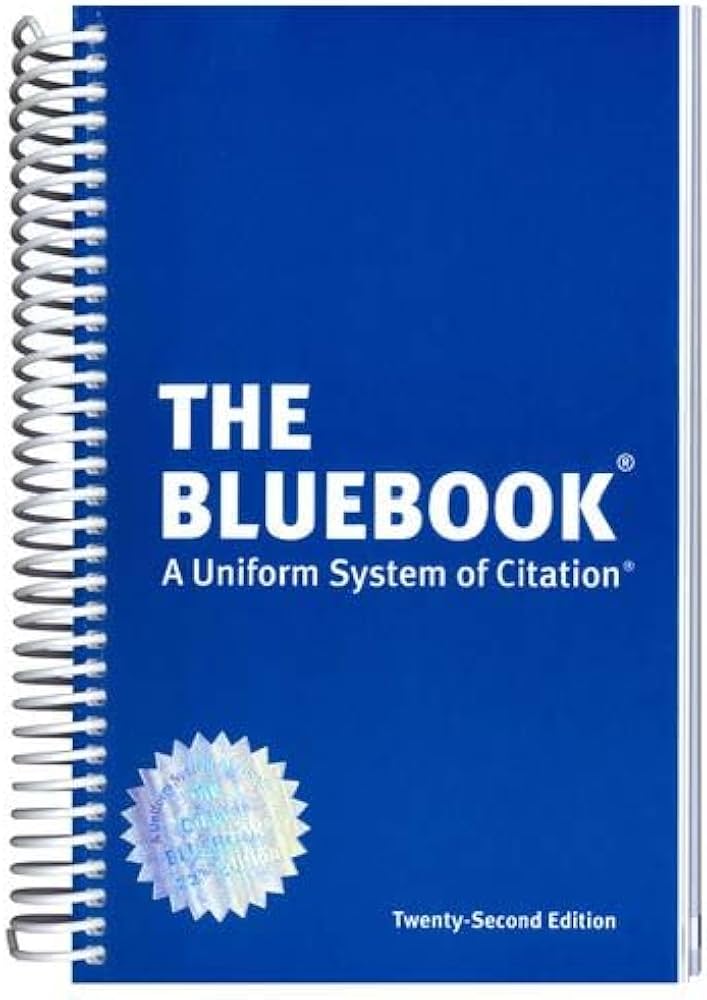
Image source: Amazon.com
How to Cite AI-Generated Content Under the New Rule 18
The most anticipated update in the 22nd edition is the comprehensive rewrite of Rule 18 to address the "AI frontier." As Large Language Models (LLMs) like ChatGPT and Claude become tools for preliminary research and drafting, the "Big Four" law reviews recognized the need for a standardized citation framework. The new Rule 18 provides a specific decision tree for citing AI-generated text, ensuring that the use of these tools is transparent and verifiable.
The 22nd edition prioritizes digital-first research standards. In many scenarios, the manual now prefers digital sources over print-equivalent PDFs, provided the digital source is archived or comes from a trusted database. When citing AI, the goal is to provide enough information so a reader can understand the specific model used and the timeframe in which the output was generated, as AI models are constantly updated.
Step-by-Step AI Citation Workflow
- Identifying the AI Model and Version: You must specify the exact model (e.g., GPT-4o, Claude 3.5 Sonnet) rather than just the company name. This is crucial because different versions produce vastly different legal analyses.
- Determining the Prompt and Output Date: Because AI outputs are non-deterministic, the date the prompt was entered is a mandatory component of the citation. This helps researchers understand the "knowledge cutoff" of the model at that time.
- Formatting the Parenthetical Explanation: The 22nd edition requires a parenthetical that describes the prompt or the nature of the AI's contribution (e.g., "generating initial case list" or "summarizing statutory history").
This framework ensures that while AI can be used as a supplementary tool, its role is clearly delineated in the legal record. This prevents the "hallucination" of cases from being attributed to human error alone and maintains the integrity of the adversarial process.
Comparing the 21st and 22nd Editions Side-by-Side
For those who have spent years mastering the 21st edition, the transition requires unlearning several deeply ingrained habits. The changes range from minor punctuation shifts to major changes in how court documents are referenced. The shift from "ECF" (Electronic Case Filing) to "Dkt." (Docket) is perhaps the most frequent change practitioners will make, reflecting the terminology used in modern PACER systems.
| Feature/Rule | 21st Edition (Old) | 22nd Edition (New) |
|---|---|---|
| Court Filings | ECF No. 12 | Dkt. 12 |
| New Signal | N/A | "contrast" (Rule 1.2) |
| Quotations | Complex parentheticals | "(citation modified)" (B5.3) |
| Web Archiving | Suggested (Perma.cc) | Required/Preferred (Rule 18.2.1) |
| Typeface Terminology | Large and small capitals | Small capitals |
The introduction of the "(citation modified)" parenthetical under Rule B5.3 is a significant advancement for clarity. Previously, authors had to use a string of parentheticals like "(internal quotation marks omitted)" and "(alteration in original)." The new rule allows for a more streamlined approach when multiple minor changes are made to a quote for readability, provided the core meaning remains intact. This reflects a broader trend toward making legal writing less cluttered and more accessible.
How to Comply with the New Archival Requirements Using Perma.cc
Link rot is a persistent problem in legal scholarship. Studies have shown that a significant percentage of links in Supreme Court opinions no longer point to the original source. To combat this, Rule 18.2.1 now mandates the use of archived versions for web citations. While the 21st edition suggested archiving, the 22nd edition makes it a requirement for academic writing and a strong recommendation for practitioners.
Perma.cc, a service developed by the Harvard Library Innovation Lab, stands out as a top choice for meeting this requirement. It allows authors to create a "permanent" snapshot of a webpage as it appeared at the time of citation. If a webpage cannot be archived publicly due to paywalls or privacy settings, the 22nd edition allows for the "copy on file with author" parenthetical. However, this should be a last resort.
According to the University of Washington Law Library's guide , authors should prioritize archiving any source that does not have a stable, permanent URL (like a DOI or a government-hosted PDF). This ensures that future researchers can verify the claims made in a brief or law review article even if the original website disappears.
Where Can You Find the 30-Day Free Trial Code?
One of the most useful features for students and new associates is the 30-day free trial of the Bluebook Online. Many users purchase the physical book without realizing they have immediate access to the digital version. The activation key is hidden in plain sight: it is located on the back of the title page of the physical 22nd edition manual.
The Online Edition offers several advantages over the print version, including "Intelligent Search" and the ability to "Pin" (bookmark) frequently used rules. For those transitioning from the 21st edition, the official LegalBluebook.com site confirms that user "Pins" will automatically migrate to the 22nd edition interface once the account is upgraded. This prevents the loss of years of personalized notes and shortcuts.
Why Your Law Library Might Not Provide Online Access
A common frustration among law students is the discovery that their university library does not provide a "site license" for the Bluebook Online. Unlike Westlaw or LexisNexis, which are typically provided through institutional subscriptions, the publishers of The Bluebook (the "Big Four") generally restrict the Online Edition to individual subscriptions. This means that even if your library has dozens of physical copies, you will likely need to pay for your own digital access.
The cost analysis for the 22nd edition varies based on your needs. A new print copy typically retails for approximately $50, while rentals can be found for around $30. The online subscription is often the most cost-effective for those who only need access during a single clerkship or semester. Furthermore, the 22nd edition is expected to hold a high buyback value—estimated at $18 or more through 2026—making the net cost of the physical book relatively low for those who plan to sell it after the bar exam.
How to Cite Tribal Nation Materials and Archival Sources
The 22nd edition makes significant strides in inclusivity and historical accuracy through the expansion of Rules 22 and 23. These rules provide much-needed guidance on citing Tribal Nation materials and historical archives, areas that were previously underserved by the manual. This expansion was developed in consultation with tribal legal experts to ensure that the sovereignty of Tribal Nations is respected in legal citations.
A key addition is Table T1.5 , which lists Federally Recognized Tribal Nations. This table provides the specific abbreviations and citation formats for tribal courts and constitutions. Notably, Table T1.5 is available for free on the official Bluebook website, ensuring that even those without the full manual can cite tribal law correctly. This reflects a growing recognition of tribal courts as essential components of the American legal landscape.
Avoiding the "Bluepages Trap" in Academic Writing
For first-year law students (1Ls), the "Bluepages Trap" is a frequent source of lost points on legal writing assignments. The Bluepages, located at the very front of the manual, are designed specifically for practitioners writing court documents (briefs, motions, memos). The Whitepages, which make up the bulk of the book, are for academic writing (law review articles, notes, seminars).
The trap occurs because the Bluepages appear first, leading students to assume they are the "standard" rules. However, the formatting requirements differ significantly. For example, the Bluepages often allow for underlining where the Whitepages require italics or small capitals. When writing a law review note, using Bluepages formatting is a major error. Always check the top of the page to ensure you are in the correct section for your specific project.
Frequently Asked Questions
- Is the 21st edition still acceptable for court filings in 2026?
- While most courts allow a brief grace period during the transition, the 22nd edition is widely considered the authoritative standard as of January 2026. Using the 21st edition (such as the "ECF" format) in a 2026 filing may signal to a judge or clerk that your research is not fully up to date. It is a top choice to switch to the 22nd edition rules as soon as the new year begins.
- How do I cite a PDF found on the internet in the 22nd edition?
- Under the new Rule 18.2.1, you should prioritize citing the PDF as if it were a print source if it is a "digital-first" official document. However, you are now required to include an archival link (like Perma.cc) or indicate that a copy is "on file with author" to prevent issues with link rot. The 22nd edition places a much higher premium on the permanence of digital sources than previous versions.
- Can I access the Bluebook 22nd edition for free?
- There is no permanent free version of the full manual. However, you can access a 30-day free trial of the Online Edition using the code found on the back of the title page of the physical book. Additionally, some specific tables, like Table T1.5 for Tribal Nations, are provided for free on the official LegalBluebook website to support broader legal accuracy.
- What is the "(citation modified)" parenthetical used for?
- Introduced in Rule B5.3, this parenthetical is a notably innovative way to streamline citations. It replaces the need for multiple, clunky parentheticals like "(internal quotation marks omitted)" or "(alterations in original)" when you have made minor changes to a quote for clarity or flow. It is one of the most popular updates for editors who want to reduce the "clutter" in footnotes.
- Does the online version update automatically?
- Yes. If you have an active subscription to the Bluebook Online, the interface will automatically update to the 22nd edition. Most users find the digital toggle feature helpful, as it allows you to switch back to the 21st edition if you are working on a project that began before the 2026 adoption deadline.
Mastering the 22nd edition is essential for any legal professional or student operating in 2026. The manual reflects a modern, tech-forward approach to citation that prioritizes digital permanence and acknowledges the role of AI in research.
To stay ahead of the curve, begin integrating the "Dkt." and "(citation modified)" rules into your current drafts to ensure a smooth transition by the January 2026 deadline.
All trademarks, copyrighted content, and quoted material referenced in this article belong to their respective owners. Brief excerpts are used under fair use (17 U.S.C. § 107) for purposes of commentary, criticism, and informational reporting. This article is not affiliated with or endorsed by the Harvard Law Review Association or its partner journals.