Home
How to Find and Use an Editable New Zealand Utility Bill Template Safely
An editable New Zealand utility bill is primarily used by landlords for tenant billing or by individuals for residency verification. To be considered valid, a document must include the GST number (e.g., Mercury's 71-048-870), a clear kWh usage breakdown , and the specific 7 cost components mandated by the Electricity Authority. While templates offer convenience, banks like ANZ or BNZ often require original PDFs downloaded directly from provider portals to pass metadata verification.
Why You Might Need an Editable New Zealand Utility Bill
In the modern New Zealand administrative landscape, the demand for editable utility documents stems from two distinct needs: professional property management and personal identity verification. For many, a standard utility bill serves as more than just a request for payment; it is a foundational document for establishing residency and managing shared financial responsibilities.
The Landlord and Property Management Use Case
Independent landlords across Aotearoa often find themselves in a position where they must bill tenants for utilities that are not individually metered. In these scenarios, using a professional-looking template allows the landlord to present a clear, itemized breakdown of costs. This practice helps maintain transparency and ensures compliance with the Residential Tenancies Act by providing tenants with the same level of detail they would receive from a direct provider like Genesis or Meridian.
Verification for Banking and Government Services
New Zealand's "Know Your Customer" (KYC) regulations are stringent. Whether you are opening an account with ASB, applying for a mortgage with Westpac, or setting up a RealMe identity, a utility bill is a top-tier proof of address. However, as digital security evolves, the reliance on "editable" versions has become complex. While a template might help in personal budgeting or as a placeholder, official entities increasingly look for the "official first" approach—documents generated directly by the utility provider's billing system.
According to residency verification standards, a document must typically be dated within the last three months and clearly show the service address matching the applicant's records. For those who have recently moved or are in transitional housing, an editable template can serve as a temporary record-keeping tool, though its acceptance for legal purposes is limited by the verification depth of the receiving institution.
What Information Must Appear on a Valid New Zealand Utility Bill?
To ensure a New Zealand utility bill—whether edited or original—is considered credible, it must adhere to specific regional standards. A missing GST number or an incorrect calculation of levies can immediately flag a document as unofficial.
Core Identifiers
Every bill must feature the customer's full legal name, the physical service address (which may differ from the postal address), a unique account number, and the specific statement date.
Financial Totals
The document must clearly state the total amount due, the payment due date, and a summary of the previous balance, payments received, and new charges.
Usage Metrics
For electricity, this means showing kWh (kilowatt-hours). For gas or water, it involves units or cubic meters. A bill without usage data is rarely accepted as a valid utility statement.
The Crucial GST Requirement
In New Zealand, for a utility bill to serve as a "Tax Invoice" for business purposes, it must prominently display the provider's GST number. For example, Mercury Energy's GST number is 71-048-870 . Without this 8 or 9-digit identifier and the specific phrase "Tax Invoice," the document does not meet IRD standards for GST claims.
Furthermore, the calculation must be precise. New Zealand's GST is 15%. On a bill, this is often shown as the GST-exclusive amount plus 15%, or as a component of the total (which equates to approximately 13.04% of the GST-inclusive total). Any discrepancy in this math is a common pitfall for those using generic global templates that do not account for NZ-specific tax logic.
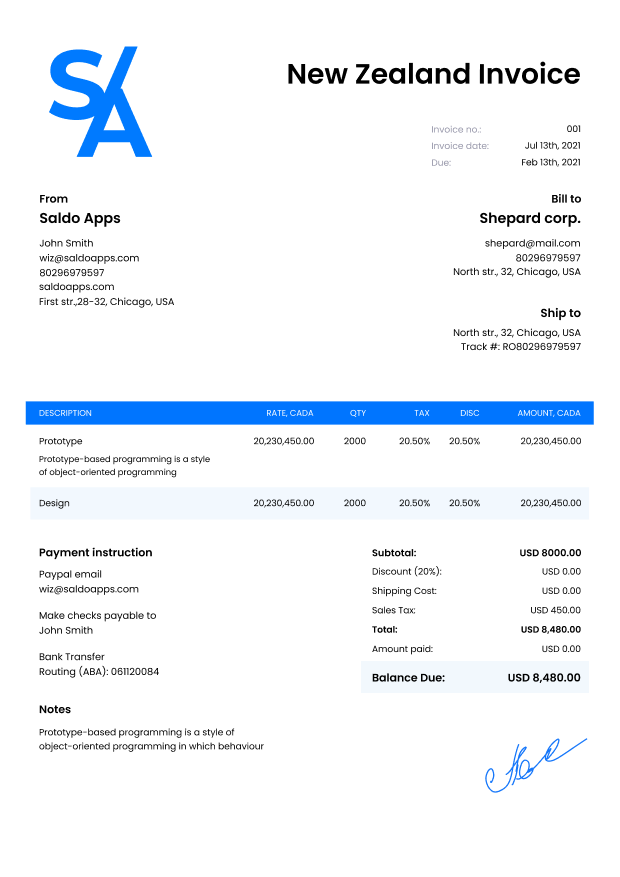
Image source: Invoice Maker by Saldo Apps
How to Download an Official PDF Bill from Major NZ Providers
Before reaching for an editable template, it is highly recommended to attempt retrieving an official PDF. These documents are widely regarded as the gold standard for verification because they contain original metadata and provider-specific security features.
Mercury Energy and Legacy Trustpower
Following the merger of Trustpower's retail business into Mercury, the process for accessing bills has been streamlined. Users should log into the Mercury "My Account" portal. From the dashboard, navigate to the "Bills & Payments" tab. Here, you can view a history of your statements. Selecting "Download PDF" provides a document that is identical to the one sent via post, complete with the official Mercury branding and the necessary GST information.
Genesis Energy and Contact Energy
Genesis Energy offers a robust mobile app that allows users to export a "Proof of Account" or a standard monthly statement directly to their email or cloud storage. Contact Energy provides similar functionality through their online portal, where bills are typically archived for at least 24 months. If you are a new customer and haven't received your first bill yet, most providers can issue a "Welcome Letter" or "Account Confirmation" which serves as a top-tier alternative for proof of address.
Why Banks and RealMe Might Reject an Edited Utility Bill
As financial institutions in New Zealand upgrade their security systems, the ability to detect modified documents has increased significantly. Understanding these hurdles is essential for anyone considering the use of an editable template for official purposes.
| Feature | Official Provider PDF | Editable Template |
|---|---|---|
| Metadata | Shows origin from provider servers | Often shows "Word" or "Photoshop" as creator |
| Digital Signatures | Encrypted and tamper-evident | Usually missing or broken |
| Font Consistency | Matches corporate branding exactly | May have slight variations in kerning |
| Verification Success | High (99%+) | Low to Moderate |
Metadata and Digital Forensics
Every PDF file contains hidden metadata—a digital footprint that records the software used to create the file and the date it was last modified. When a bank officer uploads a document into their verification system, the software checks if the metadata matches the purported source. If a "Mercury Energy" bill shows it was saved using "Microsoft Word" or "Adobe Illustrator" just minutes before submission, it will likely be flagged for manual review or immediate rejection.
The RealMe Standard
The New Zealand government’s RealMe service sets a high bar for identity verification. They often require documents to be uploaded in their original, unaltered format. Modern utility providers use digital signatures that "break" if the text within the PDF is changed. This ensures that the kWh usage and address details remain exactly as the provider intended, preventing the use of modified documents in high-stakes applications like passport renewals or residency filings.
Creating an IRD Compliant Invoice for New Zealand Landlords
If you are a landlord creating a bill for a tenant, your document must meet the Inland Revenue Department (IRD) requirements to be considered a valid tax invoice. This is particularly important if your tenant is a business or a contractor who needs to claim GST expenses.
To quickly verify if an NZ bill's GST is calculated correctly, divide the total amount by 1.15. The difference between the total and this result is the GST. Alternatively, multiplying the total by 0.1304 gives a very close approximation of the GST component.
To remain compliant with the MBIE Model Electricity Bill standards, your invoice should include:
- The words "Tax Invoice" in a prominent position.
- The name and GST number of the supplier (the landlord or the utility company).
- The name and address of the recipient (the tenant).
- A description of the services (e.g., "Electricity usage for the period 01/08/2026 to 31/08/2026").
- The total amount payable and the GST component clearly identified.
Using an Excel-based template is often a top choice for landlords because it allows for automatic calculations, reducing the risk of mathematical errors that could lead to disputes with tenants or issues during an IRD audit.
Understanding the Seven Cost Components of Your Power Bill
A realistic New Zealand utility bill is not just a single number; it is a composite of seven distinct charges. According to the Electricity Authority (EA) , understanding these components is key to accurate billing and budgeting.
- Generation (approx. 32%): The cost of producing electricity via New Zealand's renewable sources like hydro, wind, and geothermal.
- Transmission (approx. 10%): The cost of moving electricity across the national grid, managed by Transpower.
- Distribution (approx. 27%): Fees paid to local lines companies (like Vector in Auckland or Orion in Christchurch) to deliver power to your door.
- Retail (approx. 16%): The provider's margin for customer service, billing, and marketing.
- Metering (approx. 4%): The cost of providing and reading the physical meter at the property.
- Levies (approx. 1%): Small fees that fund the Electricity Authority and other regulatory bodies.
- GST (15%): The standard goods and services tax applied to the sum of all the above.
When using an editable template, ensuring these ratios are somewhat realistic adds a layer of authenticity. For instance, a bill that shows distribution costs as 80% of the total would be immediately recognizable as inaccurate to anyone familiar with the New Zealand energy market.
How the 2026 Electricity Authority Mandate Changes Your Bill Layout
The landscape of New Zealand utility billing is currently undergoing a significant shift due to new regulations aimed at consumer empowerment and transparency.
Providers used vastly different terminology and layouts, making it difficult for consumers to compare plans or verify charges easily.
All New Zealand electricity retailers must adopt "plain language" standards and a more consistent bill structure as mandated by the EA.
Bills will now include standardized usage summaries and clearer "best plan" notifications, helping Kiwis save on their energy costs.
For those using templates, this means that older designs (pre-2026) may soon look outdated. A modern, compliant template must now prioritize clarity, using simple terms like "Daily Charge" and "Usage Charge" rather than obscure industry jargon. This regulatory change is a significant advancement in consumer rights, ensuring that every household can understand exactly what they are paying for.
Troubleshooting Common Discrepancies in NZ Utility Bills
Whether you are reviewing an official statement or preparing a bill for a tenant, certain discrepancies frequently arise in the New Zealand market. Identifying these early can prevent billing disputes and verification failures.
Actual vs. Estimated Readings
One of the most common points of confusion is the "Reading Type." If a provider cannot access a meter (or if a smart meter fails to communicate), they will issue an Estimated (E) bill based on historical usage. These are often corrected in the following month with an Actual (A) reading. An authentic-looking bill should always specify which type of reading was used, as a string of "Actual" readings during a period of known meter access issues can be a red flag.
The "April Spike" Phenomenon
In New Zealand, many households see a sharp increase in their utility bills starting in April. This is not just due to increased heater usage as winter approaches; it is also when many lines companies adjust their distribution rates. Furthermore, the transition from "Low User" to "Standard User" plans—a distinction unique to the NZ market—can cause significant price jumps if a household's annual usage exceeds 8,000 kWh (or 9,000 kWh in the lower South Island).
Low User vs. Standard User Rates
When editing a bill, it is vital to choose the correct rate category. Low User plans have a lower daily fixed charge but a higher per-kWh rate, making them a top choice for energy-efficient apartments. Standard User plans are the opposite, favoring large families with high consumption. Mixing these up (e.g., applying a low daily charge with a low kWh rate) results in a bill that is mathematically impossible under current NZ pricing structures.
Key Takeaways for Managing New Zealand Utility Documents
Navigating the world of utility bills in Aotearoa requires a balance of technical accuracy and an understanding of local regulations. Here are the essential points to remember:
- Verify the GST Number: Always ensure the provider's 8 or 9-digit GST number is present for IRD compliance.
- Check the Metadata: Be aware that banks can detect edits in PDF files; original portal downloads are always a top-tier choice for verification.
- Match the 7 Components: A realistic bill should reflect the EA's cost breakdown, including generation, transmission, and distribution.
- Identify Reading Types: Distinguish between "Actual" and "Estimated" readings to maintain document credibility.
- Stay Current with Mandates: Ensure layouts reflect the post-October 2026 "plain language" requirements.
- Use the 13.04% Rule: Quickly double-check GST math by calculating 13.04% of the total inclusive amount.
- Prioritize Official Sources: Use provider apps (Mercury, Genesis) to export verified statements whenever possible.
For the most reliable results, always cross-reference your utility documents with the latest guidelines from the Electricity Authority and your specific provider's billing portal.
Frequently Asked Questions