Home
How to Choose the Right Alternating Synonym for Your Writing and Technical Projects
An alternating synonym is a word used to describe a sequence where different elements follow each other repeatedly. Depending on your context, top choices include rotating (for shifts or cycles), oscillating (for physical movement), or intermittent (for irregular frequency). While "alternate" refers to a specific A-B-A-B pattern, "alternative" refers to a choice between options.
When you are looking for an alternating synonym , the challenge often lies in the nuance of the pattern you are describing. Is the change predictable and rhythmic, or is it sporadic and fitful? In the English language, "alternating" functions as the present participle of the verb alternate , which Merriam-Webster defines as placing or doing different things so that one follows the other in a repeated series.
A simple thesaurus list often fails to provide the right "vibe" for your specific project. For example, describing a heartbeat as "rotating" would be medically confusing, just as describing a work schedule as "oscillating" might sound overly mechanical. This guide explores the deep contextual utility of these terms to help you achieve precision in your writing.
What Are the Most Common Synonyms for Alternating?
To find the most appropriate replacement, it helps to categorize synonyms by the type of "alternation" they represent. According to Power Thesaurus , there are over 570 variations, but they generally fall into three main buckets.
The "Every Other" Category
These words focus on sequence and order . Use these when describing things that happen in a fixed, predictable turn.
- Rotating
- Sequential
- Serial
- Every other
Example: "The team used a rotating schedule to ensure everyone had weekends off."
The "Back and Forth" Category
These words focus on physical or emotional movement . Use these when something moves between two points or states.
- Oscillating
- Fluctuating
- Swaying
- Reciprocating
Example: "The oscillating fan provided a steady breeze across the entire room."
The "On and Off" Category
These words focus on frequency and timing . Use these when something stops and starts, regardless of the pattern's regularity.
- Intermittent
- Periodic
- Recurrent
- Cyclic
Example: "We experienced intermittent Wi-Fi signals during the heavy thunderstorm."
Choosing between these requires understanding the "movement" of the word. Does it spin (rotate), swing (oscillate), or simply repeat (cyclic)? By matching the synonym to the physical or temporal reality of the situation, you improve the clarity of your prose significantly.
Should You Use Alternate or Alternative?
One of the most frequent points of confusion in English is the distinction between "alternate" and "alternative." While they share a root, their formal usage in professional writing is distinct. Mixing them up is a common pitfall that can detract from the authority of your work.
The Sequence vs. Choice Distinction
The word alternate refers to a pattern or sequence. If you have "alternate meetings," it means you meet every other week (Week A, then Week B, then Week A). It describes a "one after the other" relationship.
In contrast, alternative refers to a choice or a backup option. If you have an "alternative plan," it means you have a different path you can take if the first one fails. It describes a "one instead of the other" relationship.
In casual American English, people often say "I have an alternate route" when they mean a different option. However, in formal writing, "alternative route" is the more precise term for a choice. Use "alternate" only when you mean the route changes back and forth or follows a specific sequence.
Regional Differences in Usage
It is worth noting that US and UK English occasionally blur these lines in casual speech. In the UK, "alternative" is strictly used for choices, while "alternate" is strictly for sequences. In the US, "alternate" is increasingly used as a synonym for "substitute" (e.g., an "alternate juror"). Despite this trend, maintaining the distinction in formal prose ranks among the top ways to demonstrate linguistic precision.
How to Choose a Synonym Based on Predictability and Rhythm
Not all alternating patterns are created equal. Some are as steady as a metronome, while others are as chaotic as a flickering candle. WordHippo highlights that distinguishing between "occurring in turn repeatedly" and "intermittent intervals" is vital for accurate description.
Predictable and Uniform Patterns
When the alternation is steady and reliable, you should use words that evoke a sense of rhythm. Rhythmic , metrical , and steady are excellent choices here. These words suggest a pattern that the reader can anticipate, such as the ticking of a clock or the changing of the seasons.
Unpredictable and Irregular Patterns
When the alternation is broken, erratic, or lacks a clear tempo, you need words that convey instability. Fitful , sporadic , and episodic are top-tier options for these scenarios. For instance, a patient’s "fitful sleep" suggests they are waking up and falling back asleep without a predictable rhythm.
| Synonym | Predictability Level | Best Context | Example Sentence |
|---|---|---|---|
| Cyclic | High | Nature, Economics | The cyclic nature of the markets requires patience. |
| Rhythmic | High | Music, Physicality | The rhythmic thumping of the drum filled the hall. |
| Intermittent | Medium | Weather, Technology | Intermittent showers are expected throughout the day. |
| Erratic | Low | Behavior, Mechanics | The engine made an erratic, alternating clicking sound. |
| Fitful | Low | Sleep, Energy | He fell into a fitful slumber after the long journey. |
Technical Synonyms for Science and Industry
In specialized fields, general synonyms like "varying" are often too vague. Professionals use industry-specific terminology to describe alternating patterns with mathematical or physical precision.
Botany: Describing Leaf Arrangements
In the world of plant biology, "alternating" has a very specific structural meaning. The term alternifoliate describes leaves that are arranged at different levels on opposite sides of the stem. This is contrasted with "opposite" leaves, which grow in pairs directly across from each other. For a botanist, using the word "alternating" is a functional description of a plant's morphology.
Electronics: Power and Waves
When discussing electricity, "alternating" refers to the periodic reversal of the direction of electron flow. While we all know "Alternating Current" (AC), engineers might use terms like sinusoidal to describe the specific wave shape of that current. Other terms include oscillating or reciprocating , particularly when describing the mechanical movement that generates the power.
Mathematics and Chemistry
In mathematics, the Dirichlet eta function is often referred to as the "alternating" zeta function because its terms alternate in sign (+ and -). In chemistry, the structure of a benzene ring is famously described as having alternating double bonds, a concept that is fundamental to understanding organic stability and resonance.
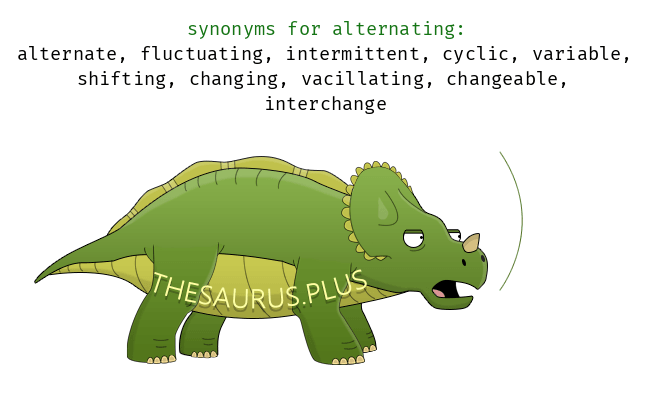
Image source: Thesaurus.plus
Expert Tips for Using Alternating Patterns in Real Life
Beyond writing, the concept of alternation plays a significant role in maintenance, health, and scientific observation. Experts often recommend alternating strategies to improve longevity and performance.
Laundry Care and Fabric Longevity
According to laundry expert Rich Handel from Consumer Reports, "alternating" the types of loads you run can prevent excessive wear on your washing machine. By alternating between heavy loads (like towels) and light loads (like delicates), you balance the mechanical stress on the drum's bearings. This simple rotation ranks among the most effective ways to extend the life of home appliances.
Health and Hydration Strategies
Dietitians frequently recommend the "1-for-1" rule during social events or in extreme heat. This involves alternating every alcoholic or caffeinated drink with a full glass of water. This rhythmic approach to hydration helps prevent dehydration and mitigates the effects of overconsumption, making it a widely regarded strategy for wellness.
Scientific Dating Methods
In environmental science, "alternating bands" found in coral reefs or tree rings serve as natural timekeepers. These bands alternate in density based on seasonal changes, allowing scientists to reconstruct historical climate data. This natural alternation is a reliable record of the Earth's history, providing a "sequential" look at centuries of environmental shifts.
A Crossword Solver’s Cheat Sheet for Alternating
If you are stuck on a crossword puzzle, "alternating" is a common clue that can lead to several different answers depending on the letter count. Here are the most frequent solutions found in major puzzle databases.
- 4-Letter Synonyms: Vary, turn. These are often used in clues related to simple changes or taking turns.
- 6-Letter Synonyms: Rotate, cyclic. These usually appear when the clue mentions a wheel, a schedule, or a repeating circle.
- 8-Letter Synonyms: Periodic, rhythmic. Look for these when the clue mentions time intervals or musical beats.
- 11-Letter Synonyms: Intermittent, fluctuating. These are the "big words" for crosswords, often clued by "stopping and starting" or "unsteady."
Frequently Asked Questions
- Is "intermittent" the same as "alternating"?
- Not exactly. While they are often used as synonyms, "alternating" usually implies a specific, repeated pattern (like A-B-A-B). "Intermittent" simply means that something stops and starts at intervals, which may or may not be regular. For example, intermittent rain might happen randomly, whereas alternating lights follow a set timer.
- What is the opposite of alternating?
- The most direct antonyms are constant , steady , and continuous . These words describe a state that does not change or shift between different modes. If a light is "steady," it stays on without blinking or changing color.
- Can I use "shifting" as a synonym for alternating?
- Yes, "shifting" is a strong choice when you are referring to moods, positions, or perspectives. It suggests a movement from one state to another, though it doesn't always imply that the movement will return to the original state as strictly as "alternating" does.
- What is a synonym for "alternating days"?
- Common phrases include "every other day," "staggered schedule," or "on a bi-daily basis" (though bi-daily can be ambiguous). In professional settings, "staggered" is often preferred when describing how different employees or groups are scheduled to avoid overlap.
- Why is it called "alternating current"?
- It is called alternating current (AC) because the flow of electric charge periodically reverses direction. It "alternates" between flowing forward and backward, usually in a sinusoidal pattern, which allows for efficient long-distance power transmission.
The Bottom Line
Choosing the right alternating synonym is about more than just avoiding repetition; it is about providing your reader with a clear mental image of how a pattern behaves over time. To ensure you select the most effective word, follow this checklist:
- Identify the regularity: Use cyclic or rhythmic for predictable patterns; use fitful or sporadic for irregular ones.
- Distinguish between choice and sequence: Use alternative for options and alternate for "every other" arrangements.
- Consider the field: Use technical terms like alternifoliate in botany or sinusoidal in physics for professional precision.
- Match the movement: Determine if the subject oscillates (swings), rotates (spins), or fluctuates (changes value).
- Check the frequency: Use intermittent for things that stop and start, and recurrent for things that happen repeatedly over long periods.
By applying these nuances, you can transform a simple description into a precise observation that resonates with your audience.
Next time you write, pause to consider if your subject is truly alternating or if a more specific term like "reciprocating" would better capture the essence of the movement.
All trademarks, copyrighted content, and quoted material referenced in this article belong to their respective owners. Brief excerpts are used under fair use (17 U.S.C. § 107) for purposes of commentary, criticism, and informational reporting. This article is not affiliated with or endorsed by Merriam-Webster, Power Thesaurus, or Consumer Reports.