Home
How to Choose the Right Alternate Synonym for Your Specific Context
The word "alternate" changes meaning based on its part of speech. To find the most accurate replacement, identify your intent first:
- Taking turns (Verb): Use Rotate or Interchange .
- Every second one (Adjective): Use Every other or Intermittent .
- A replacement person (Noun): Use Substitute or Proxy .
- A choice between options: Consider using Alternative instead.
Language is rarely static, and the word "alternate" is a prime example of lexical flexibility. Depending on whether you are writing a legal contract, a botanical study, or a database query, the "correct" synonym can shift dramatically. Research indicates that there are over 1,900 related terms and phrases for "alternate," making precise selection essential for clarity.
What Is the Most Common Synonym for Alternate?
When users search for an "alternate synonym," they are typically looking for a word that conveys the idea of replacement or rotation. In standard English, the most frequent replacements are determined by the specific action or state being described. According to major lexical resources like Cambridge Dictionary , the following are the primary choices:
- Rotate: This is the top choice when you mean to perform actions in a repeating sequence. For example, "We rotate shifts" is a direct replacement for "We alternate shifts."
- Every other: This is the preferred phrasing for sequential timing. Instead of saying "on alternate days," many writers opt for "every other day" to ensure absolute clarity for a general audience.
- Substitute: When referring to a person who fills a role in someone else's absence, "substitute" is widely regarded as the most common noun form.
Context is the deciding factor. A "backup" is not always an "alternate." A backup implies a secondary resource kept in reserve, whereas an alternate often implies a pre-selected replacement or a rhythmic switching. Understanding these nuances prevents the "word salad" effect where synonyms are technically correct but contextually jarring.
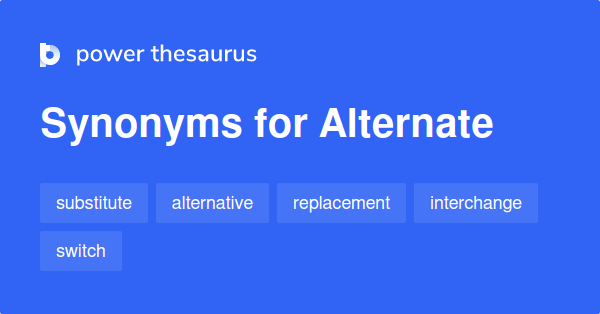
Image source: Power Thesaurus
Alternate vs. Alternative — Which One Should You Actually Use?
One of the most persistent points of confusion in English grammar is the distinction between "alternate" and "alternative." While many casual speakers use them interchangeably, professional style guides—such as those from the Associated Press and the Chicago Manual of Style—maintain a strict boundary between the two.
The Rotation Rule (Alternate)
Use "alternate" when you are describing a sequence, a rhythm, or a process of taking turns. It suggests a back-and-forth movement. Example: "The interior designer chose a pattern of alternate red and white stripes."
The Choice Rule (Alternative)
Use "alternative" when you are describing a choice between two or more mutually exclusive options. It implies the power to select one path over another. Example: "We are looking for an alternative energy source to replace coal."
| Term | Primary Usage | Key Synonym | Example |
|---|---|---|---|
| Alternate | Sequence/Rotation | Every other | "We meet on alternate Tuesdays." |
| Alternative | Choice/Option | Selection | "Is there an alternative route?" |
| Option | Power to choose | Election | "You have the option to stay." |
Synonyms for Alternate When Used as a Verb
As a verb, "alternate" describes the action of changing back and forth between states, positions, or roles. This form is highly dynamic and requires synonyms that capture the specific "vibe" of the movement.
Physical and Mathematical Motion
When describing physical objects or data points that move back and forth, words like oscillate and fluctuate are top-tier choices.
- Oscillate: Best for rhythmic, predictable movement (like a pendulum).
- Fluctuate: Best for unpredictable or unstable changes (like stock prices).
- Sway: Used for physical movement that is less mechanical and more fluid.
Sequential Action and Rotation
In a professional or organizational setting, you might use rotate , interchange , or stagger .
- Rotate: Implies a cycle (e.g., rotating crops).
- Stagger: Implies an arrangement of things in a non-aligned or alternating time frame (e.g., staggered work hours).
- Interchange: Suggests a mutual swap between two specific entities.
Mental and Emotional States
When a person's mind moves between two choices or feelings, "alternate" can be replaced by vacillate or waver .
- Vacillate: This is a sophisticated synonym for mental indecision. If you are "alternating" between two opinions, you are vacillating.
- Waver: Suggests a loss of steadiness or a moment of doubt before choosing.
Synonyms for Alternate When Used as an Adjective
The adjective form of "alternate" describes the nature of a sequence. It tells the reader "how" something occurs in time or space.
Timing and Frequency
Words like intermittent , recurrent , and periodic are excellent for describing events that happen by turns.
- Intermittent: Suggests stopping and starting at irregular intervals.
- Recurrent: Suggests something that happens repeatedly, often after a period of absence.
- Periodic: Implies a very strict, timed interval.
Structural and Botanical Contexts
In the world of biology and botany, "alternate" has a very specific meaning regarding leaf arrangements. Leaves that are "alternate" are not paired; they grow from different points on the stem.
- Opposite: The direct antonym in botany, where leaves grow in pairs.
- Wavelike: Used in physics to describe alternating patterns of peaks and troughs.
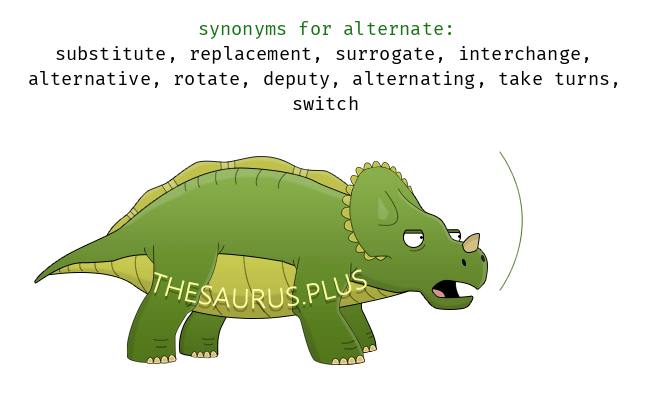
Image source: Thesaurus.plus
Synonyms for Alternate When Used as a Noun
As a noun, an "alternate" is a person or thing that stands ready to take the place of another. This is common in committees, sports teams, and legal documents.
Professional and Formal Replacements
In formal environments, you might use proxy , surrogate , or understudy .
- Proxy: A person authorized to act on behalf of another, especially in voting.
- Surrogate: A person appointed to act in the place of another, often in a more personal or medical capacity.
- Understudy: Specifically used in the performing arts for an actor who learns a role to replace the lead if necessary.
- Standby: A general term for someone or something ready for immediate use.
Legal and Financial Successors
In law and finance, the term "alternate" often refers to a contingent or a successor .
- Contingent: Used for beneficiaries who only receive assets if the primary beneficiary is unable to.
- Successor: A person who succeeds another in an office or position.
- Per Stirpes: A legal term often used in wills to describe how assets are distributed among "alternate" descendants.
Industry-Specific Synonyms You Won't Find in a Standard Thesaurus
Sometimes, a standard dictionary isn't enough. Niche industries have developed their own "alternate" vocabularies that provide much higher precision.
- Creative Writing: When discussing "Alternate Universes," writers often use terms like Multiverse , Parallel Dimension , or Uchronia (specifically for alternate history). In the DC Comics fandom, these are famously known as Elseworlds .
- Gaming: If you are looking for "alternate costumes" for a character, the gaming community uses Skins , Palettes , Transmogs (in MMOs), or Echo Fighters (in fighting games).
- Aviation: Pilots don't just look for an "alternate airport"; they look for a Diversion Field or a Reliever Airport .
- Logistics: Supply chain managers look for Redundant Sources or Secondary Suppliers to ensure stability.
Technical Alternatives to SQL Synonyms for Database Performance
For database administrators (DBAs), the term "synonym" has a technical definition: it is an alias for a database object like a table or view. However, using synonyms—especially across remote database links—can sometimes lead to performance bottlenecks.
The Problem with Remote Synonyms
In Oracle databases, a public synonym is a convenient way to allow users to access a table without knowing its schema owner. However, expert discussions on the DBASupport Forum highlight that the local optimizer often struggles to "see" indexes on remote tables when accessed through a synonym or a complex view. This can lead to full table scans and slow queries.
Using a VIEW as an Alternate
A common "alternate" to a simple synonym is a VIEW . While a synonym is just a pointer, a view can include logic.
CREATE PUBLIC SYNONYM emp_table FOR hr.employees;
-- Creating a VIEW as an alternative for better control
CREATE VIEW local_emp_view AS SELECT * FROM hr.employees@remote_db;
When to Use a Private Synonym
If performance is a concern, DBAs often recommend using a PRIVATE SYNONYM instead of a public one. This limits the scope and can sometimes simplify the optimizer's path, though the impact varies based on the specific database version and configuration.
Frequently Asked Questions
While they are often used as synonyms in casual conversation, they have distinct meanings in formal writing. "Alternate" refers to a sequence or taking turns (every other), while "alternative" refers to a choice between two or more options. If you have a choice, "alternative" is usually the more accurate word.
Common synonyms for a person acting as an alternate include substitute, proxy, surrogate, standby, or understudy. The choice depends on the setting; "understudy" is for theater, while "proxy" is often used in business or voting contexts.
The antonym depends on the context. If you mean "taking turns," the opposite is "continuous" or "constant." If you mean "a replacement," the opposite is "primary," "original," or "main." In botany, the opposite of an alternate leaf arrangement is an "opposite" or "whorled" arrangement.
Writers frequently use terms like parallel world, multiverse, uchronia (for history), or divergent timeline. These terms help specify whether the "alternate" world is a separate dimension or a point where history simply took a different path.
DBAs sometimes avoid synonyms because they can hide the underlying object's location, making troubleshooting more difficult. Additionally, when using remote database links, synonyms can occasionally prevent the optimizer from using the most efficient execution plan, leading to slower performance compared to direct referencing or specific views.
The Bottom Line on Using Alternate Synonyms
Choosing the right word ensures your writing is precise and professional. Here are the key takeaways to remember:
- Identify the Part of Speech: Determine if you are describing an action (verb), a sequence (adjective), or a person (noun) before picking a synonym.
- Respect the Choice Factor: Use "alternative" for choices and "alternate" for rotations or sequences.
- Match the Intensity: Use "oscillate" for physical/rhythmic movement and "vacillate" for mental indecision.
- Consider the Industry: Use niche terms like "proxy" for business, "skin" for gaming, or "uchronia" for fiction to sound like an expert.
- Technical Caution: In databases, remember that synonyms are aliases; if you experience lag, testing a VIEW or a PRIVATE SYNONYM is a smart troubleshooting step.
- Check for Clarity: When in doubt, "every other" is often the most readable choice for a general audience.
To improve your writing immediately, try replacing "alternate" with one of these more specific terms in your next draft and see how it sharpens your message.