Home
How to Master Content Editing to Improve Your Writing and Structure
Content editing (also known as substantive or macro editing) is the process of evaluating a document's structure, logic, and flow to ensure it meets the needs of its intended audience. Unlike copy editing, which focuses on grammar and syntax, content editing addresses the "big picture" to optimize comprehensibility and visual design. It ranks among the top priorities for producing high-impact digital and traditional media.
What Is Content Editing and Why Does It Matter?
Content editing represents the architectural phase of the writing process. According to Wikipedia , it involves evaluating a document’s format, style, and content to optimize both visual design and comprehensibility. In professional circles, you may hear this referred to as substantive editing , developmental editing , or macro editing . Regardless of the label, the objective remains the same: ensuring the foundation of the piece is solid before any fine-tuning occurs.
While many writers focus on the mechanics of a sentence, a content editor looks at the document from a "cruising altitude." They ask whether the argument holds water, if the pacing keeps the reader engaged, and if the tone aligns with the brand or audience expectations. This stage is highly subjective and often requires a strong collaborative relationship between the author and the editor to succeed.
The goal of clarity is paramount. A content edit ensures that the visual elements—such as headings, bullet points, and images—work in harmony with the text to guide the reader through the information. Without this macro-level oversight, even the most grammatically perfect prose can fail if it lacks a logical progression or fails to address the reader's primary questions.
Content Editing vs. Copy Editing — Which One Do You Need?
One of the most common points of confusion in the publishing world is the distinction between content and copy editing. To produce professional-grade work, it is essential to understand the industry-standard sequence: Content Editing → Copy Editing → Proofreading . Skipping straight to the polish is often a waste of resources.
The Workflow Hierarchy
As noted by EditorWorld , polishing sentences before the structure is settled is inefficient. If a content editor determines that three paragraphs are redundant and should be deleted, any time spent copy editing those specific sentences for grammar is lost. Content editing handles the "what" and "where," while copy editing handles the "how."
| Feature | Content Editing | Copy Editing |
|---|---|---|
| Primary Focus | Structure, Logic, Pacing, Argument | Grammar, Syntax, Punctuation, Style |
| Stage | Early to Middle (Macro) | Late (Micro) |
| Typical Output | Reorganized sections, new transitions | Error-free, consistent text |
| Subjectivity | High (Collaborative) | Low (Rule-based) |
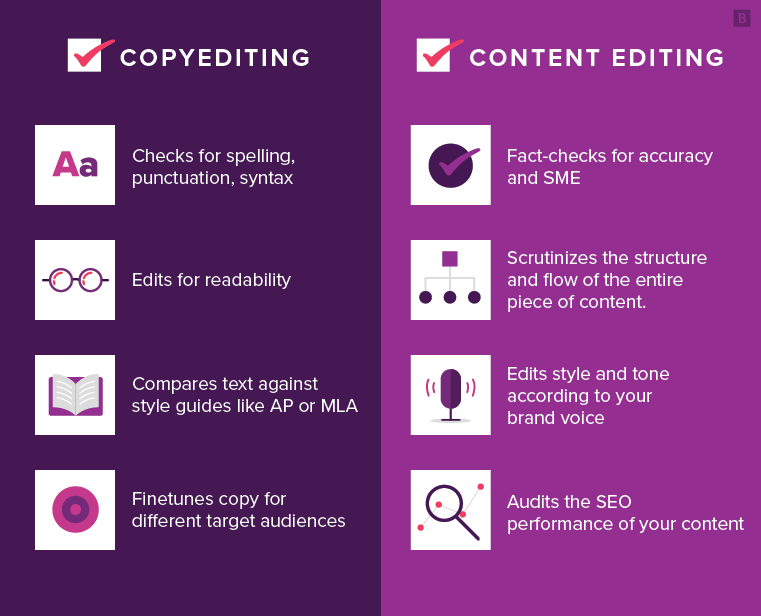
Image source: Brafton
How to Perform a Structural Content Edit in 7 Steps
Mastering the macro edit requires a systematic approach. By conceptually deconstructing the draft, you can see the "skeleton" of the work and identify where the bones might be broken.
Step 1: Deconstruct the Draft
Strip the document down to its core outline. Look at the headings and the first sentence of each paragraph. Does the progression make sense? This "conceptual deconstruction" allows you to see the flow without getting distracted by the prose.
Step 2: Evaluate the Argument or Plot
For non-fiction, ensure every claim is supported by evidence and that the conclusion follows logically from the premises. For fiction, check for plot holes or character inconsistencies that might pull a reader out of the story.
Step 3: Check for Audience Alignment
Is the complexity level appropriate? A whitepaper for C-suite executives requires a different structural approach than a "how-to" blog post for beginners. Ensure the tone matches the reader's intent.
Step 4: Optimize Flow and Pacing
Identify "logical leaps" where the reader might get lost. Move paragraphs to improve transitions and ensure that the most important information is positioned where it will have the most impact.
Step 5: Review Visual Elements
Evaluate the placement of tables, graphs, and images. As Source 1 suggests, these elements should enhance comprehensibility, not clutter the page. Ensure they are referenced correctly in the text.
Step 6: Fact-Checking and Accuracy
A structural edit is the best time to verify the foundation. Check dates, names, and statistics. According to Bynder , attention to detail at this stage prevents costly errors later in the production cycle.
Step 7: The Final Macro-Pass
Read the entire piece aloud. This helps identify "invisible" transitions and ensures the overall impact of the piece is cohesive and persuasive.
Using AI to Audit Your Content Structure and Flow
In the modern editing landscape, Large Language Models (LLMs) like Claude and ChatGPT have become valuable structural auditors. Rather than using AI to write the content, professional editors use it to find the gaps that a human eye might miss after hours of staring at the same screen.
The "Humanizer" Workflow: Use AI to perform a "logical leap" audit. By prompting the AI to "identify any sections where the transition between ideas feels abrupt," you can quickly locate areas that need better connective tissue. You can also ask the AI to "summarize the main argument of each section" to see if the machine's interpretation matches your intent.
Another effective technique is using AI to identify redundancy. LLMs are exceptionally strong at highlighting repetitive arguments or phrases that appear across long manuscripts. This allows the human editor to focus on the creative aspects of the rewrite while the AI handles the tedious task of pattern recognition.
How Content Editing Changes Across Different Platforms
Content editing is not a one-size-fits-all discipline. The requirements shift significantly depending on the medium and the platform.
Digital Marketing and SEO
In the digital space, content editing must account for search intent and keyword clusters. An editor ensures that the primary keywords are integrated naturally into the structure (H1, H2 tags) without sacrificing readability. They also check for "internal link equity," ensuring the piece connects to other relevant content on the site.
Design Integration (UX Writing)
Content editing is increasingly happening within design tools like Figma. As discussed in the Figma Community , having specific "Content Editor" roles allows writers to update text within a layout without breaking the design. This ensures that the copy fits the visual constraints of the UI, preventing awkward line breaks or overlapping elements.
Multimedia: Video and Audio
Macro principles apply to video editing as well. Techniques like J-cuts (where the audio from the next scene starts before the video) and L-cuts (where the audio from the current scene continues into the next) are essential for maintaining flow. According to Voice123 , the "Edit the story first, style second" rule is vital. If the story doesn't work when stripped of effects, the content edit has failed.
Essential Skills and Tools for Professional Content Editors
Becoming a top-tier content editor requires a blend of analytical thinking and creative intuition. A survey of professional editors found that Written Communication (93%) and Attention to Detail (88%) are the most critical skills for success. Creative thinking followed at 52%, highlighting that while creativity is important, the ability to communicate clearly and spot errors is the foundation of the craft.
The Modern Tech Stack:
- Structural Tools: Scrivener and Notion are excellent for organizing long-form projects and moving large blocks of text easily.
- Collaboration Tools: Google Docs remains a standard, but Figma is becoming a top choice for UX-focused content editing.
- Analysis Tools: Hemingway helps monitor readability scores, while Grammarly can be used to check for tone consistency across a large document.
Ultimately, content editing is about making the "invisible" work. When an editor does their job well, the reader moves through the piece without friction, never noticing the careful scaffolding that holds the argument together. It is a collaborative effort that requires a strong personality fit between the author and the editor to ensure the original vision is enhanced, not erased.
Frequently Asked Questions
In digital marketing and general business writing, these terms are often used interchangeably to describe structural, macro-level revisions. However, in the traditional book publishing world, developmental editing usually happens at the earliest stages of a manuscript's life, while substantive (content) editing occurs once a full draft is completed but still needs significant structural work.
The process typically involves: 1. Deconstruction (analyzing the outline), 2. Structural Revision (moving sections for better flow), 3. Fact-Checking (verifying data and claims), 4. Visual Integration (optimizing images and headings), and 5. Final Flow Review (ensuring smooth transitions and tone consistency).
No. Content editing is a macro-level process that addresses structure, logic, and argument. Proofreading is the very last micro-level step, focusing exclusively on catching typos, misspellings, and formatting errors after all other editing is complete. A content editor might rewrite 20% of a page, while a proofreader will only change a comma or a misspelled word.
Yes, but it is most effective as an "auditor" rather than a "writer." You can use AI to identify logical gaps, find repetitive phrases, or check if your tone matches a specific brand voice. However, the subjective nature of content editing—understanding the nuance of an audience and the specific goals of a piece—still requires human oversight to be truly effective.
Content editing is generally more expensive than copy editing because it is more time-intensive and requires a higher level of expertise. Rates vary widely based on the complexity of the subject matter and the length of the document, but it is often billed at a higher hourly rate or a higher per-word rate due to the "heavy lifting" involved in structural rewrites.
Final Thoughts on Mastering the Big Picture
Content editing is the essential bridge between a rough draft and a high-impact final product. By focusing on the structure before the syntax, you ensure your message is built on a solid foundation.
- Prioritize structure over grammar in the early stages of your workflow.
- Use the 20% rule as a benchmark for healthy, substantive revisions.
- Leverage AI as a structural auditor to find logical gaps and redundancies.
- Adapt your approach based on the platform, whether it's SEO, UX design, or video.
- Collaborate closely with authors to ensure the content edit enhances the original vision.
- Always fact-check during the macro phase to prevent foundational errors.
Start your next project by conceptually deconstructing your draft to ensure your argument stands strong before you ever pick up a red pen for grammar.